Does a 120 km/h limit carry more traffic than 80 or 100 km/h?
Throughput depends on vehicle speed and traffic density.1 The German capacity manual gives the same design capacity at 80, 100 and 120 km/h for an example three-lane segment.2
Speed and throughput measure different things
Throughput counts how many vehicles pass a point in a given time. Vehicles can travel faster past the same point while also being spaced farther apart. To determine how many pass, you also need traffic density or a vehicle count.1
An example from the German capacity manual
For a basic highway segment outside a metropolitan area with three lanes in each direction, a gradient of up to 2% and 10% heavy vehicles, HBS 2015 gives a design capacity of 5,300 vehicles per hour per direction for speed limits of 80, 100 and 120 km/h. That value assumes dry roads in daylight.2
Three speed settings in the simulator
The speed control sets the vehicles’ desired speed. Their actual speeds depend on traffic conditions. Each row comes from three hour-long model runs on the same road.3
On an open road, a higher desired speed adds few vehicles. Cars travel faster but leave more space. At a bottleneck, what matters is how evenly the queue discharges.
| Desired speed | Vehicles/h |
|---|---|
| 80 km/h | 6,946 |
| 100 km/h | 7,196 |
| 120 km/h | 7,352 |
Try it yourself
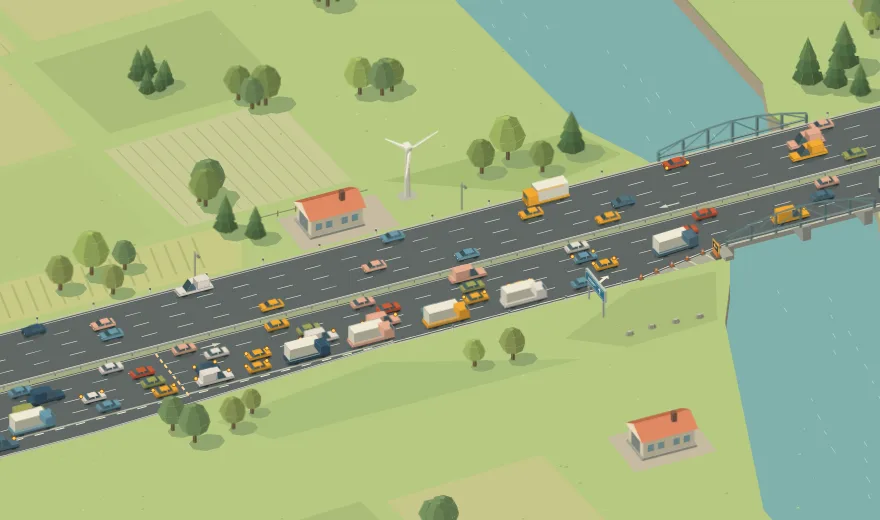
Start the three speed settings with four approach lanes and three bridge lanes. Compare the count and the queue.