
How many vehicles per hour can a two-, three- or four-lane highway carry?
In a 100 km/h example, the German capacity manual HBS 2015 gives 3,700, 5,300 and 7,200 vehicles per hour for two, three and four lanes. The third lane adds 43%, the fourth 36%.1
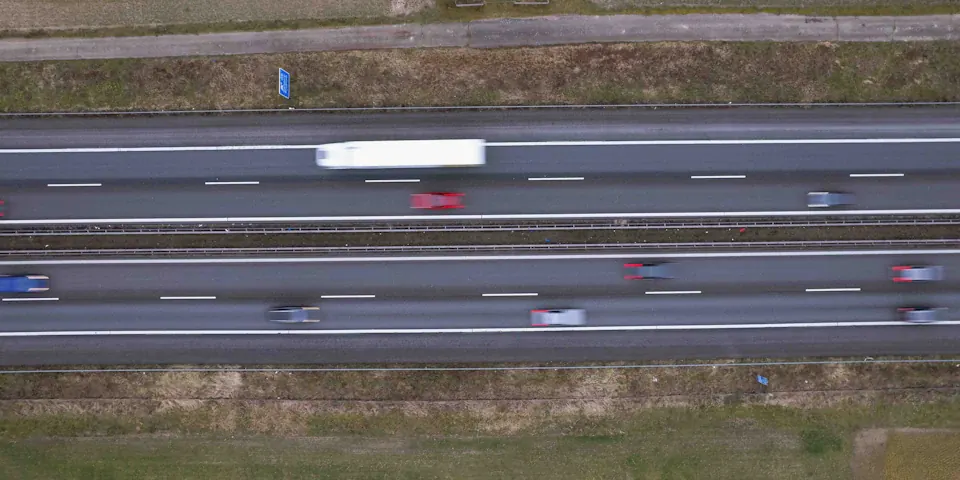
Design capacity on a basic highway segment
The example assumes a dry road in daylight outside a metropolitan area, beyond the influence of interchanges and with a gradient of up to 2%. Heavy vehicles make up 10% of traffic. In the table, 100 km/h shares a category with 80 km/h and traffic control systems.1
The German Highway Capacity Manual (HBS) uses capacity to assess traffic quality during a peak hour. The values draw on detector data from several highway segments. Heavy vehicle share, gradient and location determine the relevant row or column. Flow measured at an individual site can differ from the design value.2
| Lanes per direction | Design capacity (veh/h) | Per lane | Change from previous |
|---|---|---|---|
| 2 | 3,700 | 1,850 | — |
| 3 | 5,300 | 1,767 | +43% |
| 4 | 7,200 | 1,800 | +36% |
From a cross-section to one lane
Per lane, the three cases work out to 1,850, 1,767 and 1,800 vehicles per hour. Capacity does not grow in a straight line with lane count. Going from two to three lanes adds 1,600 vehicles per hour, 43% more. Going from three to four adds 1,900, but only 36% more than with three lanes. From two to four lanes the figure rises by 3,500 vehicles, or 95%, almost double. Each design value applies to the whole cross-section in one direction, not to a single lane.
Test it in the simulator
Compare four continuous lanes with a lane drop and read the counter beyond the bridge.