
How many cars an hour can a zipper merge or a signalised junction handle?
At a zipper merge, what matters is how many lanes stay open beyond the pinch point. At traffic lights, your direction also needs enough green time. In the traffic lab’s busy scenario, the same one-lane stretch let 1,580 vehicles through in an hour with the signal held at green. With red phases it let 1,018 through.1
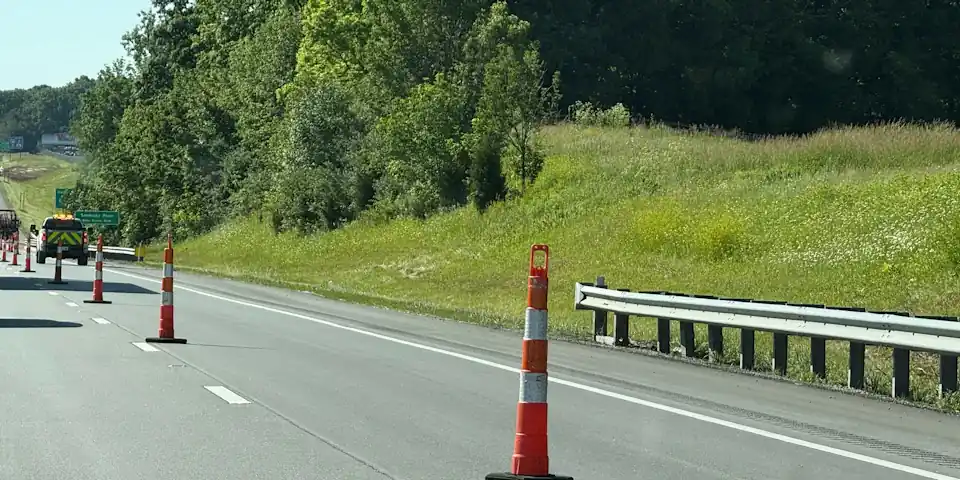
Two queues feed one lane
You reach the end of your lane and drivers take turns, one from each side. Using both lanes gives the queue more room. Every vehicle still has to fit into the lane beyond the merge. If two or three lanes stay open, more cars can keep going alongside each other. The numbers below are for one direction of travel.21
Each motorway layout ran for a full measurement hour at a desired speed of 80 km/h, with heavy demand and no entrance ramp. The US roadworks had the same lane counts. The researchers did not report how consistently drivers took turns. At other sites in the same study, three lanes narrowed to one and an average of 1,130 vehicles got through an hour. An extra lane on the approach still leaves everyone sharing the single lane beyond the merge.21
What field trials measured when drivers were asked to merge late
Using measurements from short-term motorway works in North Rhine-Westphalia, Germany’s road research institute estimated 1,275 to 1,650 vehicles an hour for two lanes narrowing to one. Its urban-area estimates for three lanes narrowing to two were 3,036 to 3,300. The estimates depend on where the work zone is and which side loses a lane. At one long-term site with a modified zipper merge into two lanes, the busiest measured hour carried 2,950 vehicles.3
On I-94 in Michigan, researchers recorded an average of 1,207 vehicles an hour in the congested afternoon peak in the direction signed for a late zipper merge. The other direction, with standard signs, averaged 990. The share of heavy vehicles differed, and the researchers had no before count for the direction with the new signs.4
Just before a three-to-two lane drop on I-30 in Texas, researchers recorded 3,239 vehicles before and 3,382 after introducing signs for a late merge. The counts covered the same 75 minutes on two Fridays. That works out at about 2,591 and 2,706 vehicles an hour. Queuing began at different times on the two days.5
Same road, same arrivals, with and without red lights
In both corridor runs, the extra lane ends 18 metres before the same stop line. The desired speed is 50 km/h. Each demand level uses the same three arrival sequences in both versions. With the signal held at green, drivers still have to merge. In the second run they get 32 seconds of green and 28 seconds of red every minute. The model counts exits over a full hour after a ten-minute warm-up. Each table entry gives the middle value of the three runs.1
At about 720 arrivals an hour, the cars fit into the green phases. You may still have to wait at a red. At about 2,160 arrivals, queues build in both versions and grow much faster with red phases. This experiment follows a single stream of traffic. It has no side street with vehicles of its own.1
| Demand setting, vehicles/h | Merge with signal held at green | Merge with red phases |
|---|---|---|
| 720 | 722 | 720 |
| 1,440 | 1,435 | 1,020 |
| 2,160 | 1,580 | 1,018 |
What the whole junction can handle
Under favourable conditions the German road capacity manual uses 2,000 vehicles an hour for one through lane if a waiting queue can keep moving. At traffic lights you multiply that rate by the share of the cycle the lane can actually use. The calculation accounts for the extra time the first cars take to pull away. At 50% effective green, one through lane can handle about 1,000 vehicles an hour. If both lanes stay open all the way through the junction, the estimate is 2,000, above the 1,340 observed at the two-to-one work zones.62
At a simple crossroads two opposing streams can go straight at the same time. Give each axis 45% effective green time and four fully loaded single-lane approaches can serve a combined 3,600 vehicles per hour in this worked example. That is 900 for any one approach. Separate turn phases, people crossing on foot or by bike, and queues beyond the junction can change how much traffic gets through.6
| Through lanes | 40% effective green | 50% | 60% |
|---|---|---|---|
| 1 | 800 | 1,000 | 1,200 |
| 2 | 1,600 | 2,000 | 2,400 |
| 3 | 2,400 | 3,000 | 3,600 |
Test it in the simulator
Set 50 km/h and 36 arrivals per minute, with the signal after the extra lane. Watch the exits and queue, then move the signal while keeping arrivals the same.
Sources
- Traffic Lab · Hourly counts at lane drops and at the same stop line, with scripts and raw results (German) ↩↩2↩3↩4↩5↩6↩7
- Dudek and Richards (1981) · Texas work-zone observations, Table 1, p. 3 ↩↩2↩3↩4
- Geistefeldt et al. (2024) · BASt V 378, motorway works, Tables 5-1, 5-2 and 5-25 (German) ↩
- Michigan DOT (2007) · Field trial with dynamic late-merge signs, Table 25 ↩
- Walters and Cooner (2001) · I-30 field trial, Table 14, p. 75 ↩
- Geistefeldt et al. (2025) · BASt V 400, Section 2.2.1 and Equation 2-7 on signal capacity (German) ↩↩2↩3