
What happens to vehicle speeds and time gaps when someone merges?
At a work zone on China’s G36, the vehicle behind the merging driver slowed by a median of nearly 5 km/h over the lane change.1 At the A13 on-ramp in Delft, the merging drivers’ average time gap to the vehicle ahead grew from 1.2 to 1.4 seconds within ten seconds.2
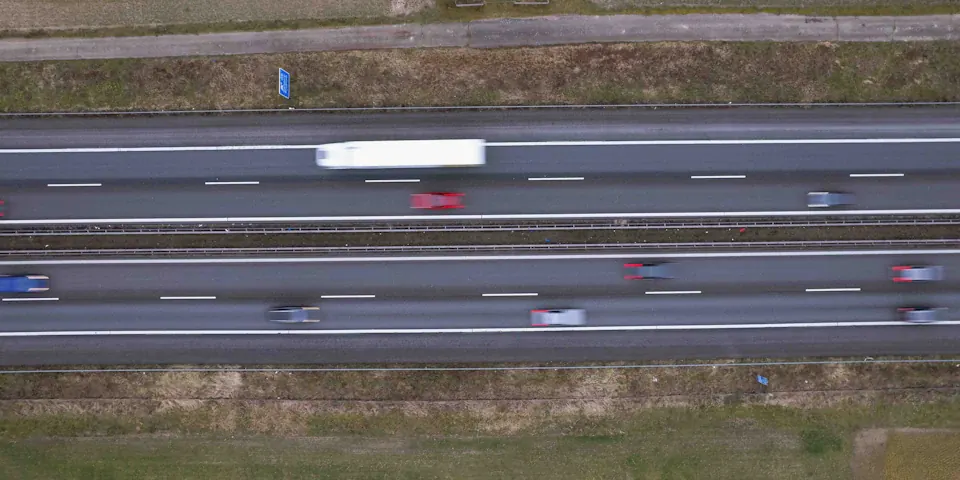
What the footage shows
In light traffic at G36 site B4, Jiao and colleagues compared the speed of the following vehicle in the receiving lane at the start and end of 638 lane changes.1
In Delft, helicopter footage captured free-flowing traffic at an on-ramp with an acceleration lane. The researchers measured the time gap ahead for 115 merging drivers who followed the same vehicle for ten seconds after the merge.2
What happened on the main road in Delft
For 97 vehicles on the main road, the researchers compared measurements ten seconds before another vehicle merged with measurements at the time of the merge. The differences in speed and time gap did not reach statistical significance in this sample. The findings apply to the two situations and measurement windows studied.21
Test it in the simulator
At the three-lane work zone, watch how speed and gap change as vehicles merge.