
What happened to traffic when Berlin closed Friedrichstraße to cars?
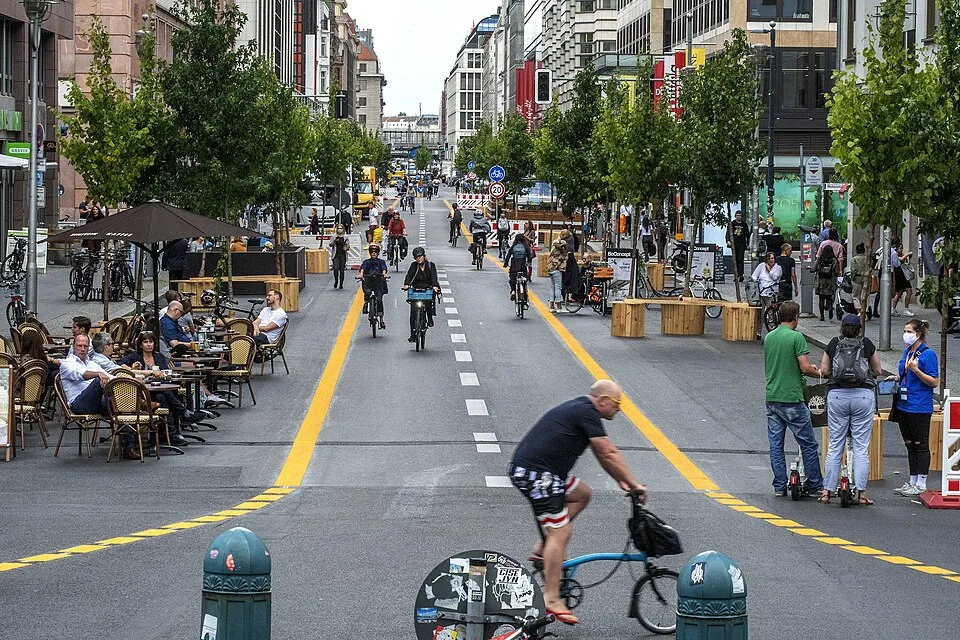
In 2021, people had room to cycle and sit out on Friedrichstraße. If you were delivering goods a few blocks away on Charlottenstraße, you could find more cars ahead of you. Berlin counted about 18,000 more motor vehicle passes there on its comparison day. Across the three streets studied, the combined count went down.1
What Berlin counted on the three streets
Berlin closed Friedrichstraße to general motor traffic between Französische Straße and Leipziger Straße for a trial that ran from 29 August 2020 to 31 October 2021. The city used video to count traffic twice before the trial and eleven times during it. For the direct comparison it chose two Thursdays in August, both outside the school holidays. By the second count, people had had almost a year to get used to the closure.13
Where drivers went
The same car can appear several times in this table if it passed more than one camera. Charlottenstraße picked up most of the diverted traffic observed nearby. The report suggests some drivers probably took routes further away. The counts leave it open whether a particular person skipped the trip, cycled instead or drove around the closure on a different street.1
On one block of Friedrichstraße, between Jägerstraße and Taubenstraße, bicycle passes rose from 3,600 to 5,620 between the two count days. Berlin also counted more people on foot there. Both counts took place during the pandemic, when the number of people making trips into the city centre was changing for other reasons too.12
What the city paid and what detours cost
In April 2022, Berlin put the gross cost of traffic surveys and analysis at about €756,600. The figure included about €592,000 in surveys under an existing contract. Setting up and running the pedestrian area brought further costs.3
If you had a delivery to make on Charlottenstraße, the extra traffic on that street mattered to you directly. The counts show how much busier it got at those locations. Estimating time lost to detours and delays would require comparable journey time data.1
How long the closure lasted
The street stayed closed after the trial. In 2022, Berlin’s administrative court ruled that the interim arrangement was unlawful and the street briefly reopened. The city created a pedestrian zone in early 2023. Drivers could use the street again from 1 July 2023. The borough formally revoked the road-use restriction in 2026. The trial counts show where traffic was recorded during the closure. The sequence of openings and closures makes the lasting effect harder to judge.4567
Test it in the simulator
Imagine some of the displaced traffic comes down your street. Raise demand in the city model and watch when the queue reaches the next junction.
Sources
- State of Berlin (2022) · Final evaluation of the traffic trial, sections 2.3 and 3.1, pp. 14 to 16 (German) ↩↩2↩3↩4↩5↩6
- LK Argus for the State of Berlin (2022) · Local traffic plan, table 18 (German) ↩↩2
- Berlin Senate (2022) · Parliamentary paper 19/11486, answers 1, 2 and 9 (German) ↩↩2
- Berlin Administrative Court (2022) · Interim ruling on the closure (German) ↩
- Berlin Senate (2023) · Creation of the pedestrian zone (German) ↩
- Berlin Senate (2023) · Reopening to motor vehicles on 1 July (German) ↩
- Berlin official gazette, 20 March 2026 · Revocation of the road-use restriction, p. 763 (German) ↩